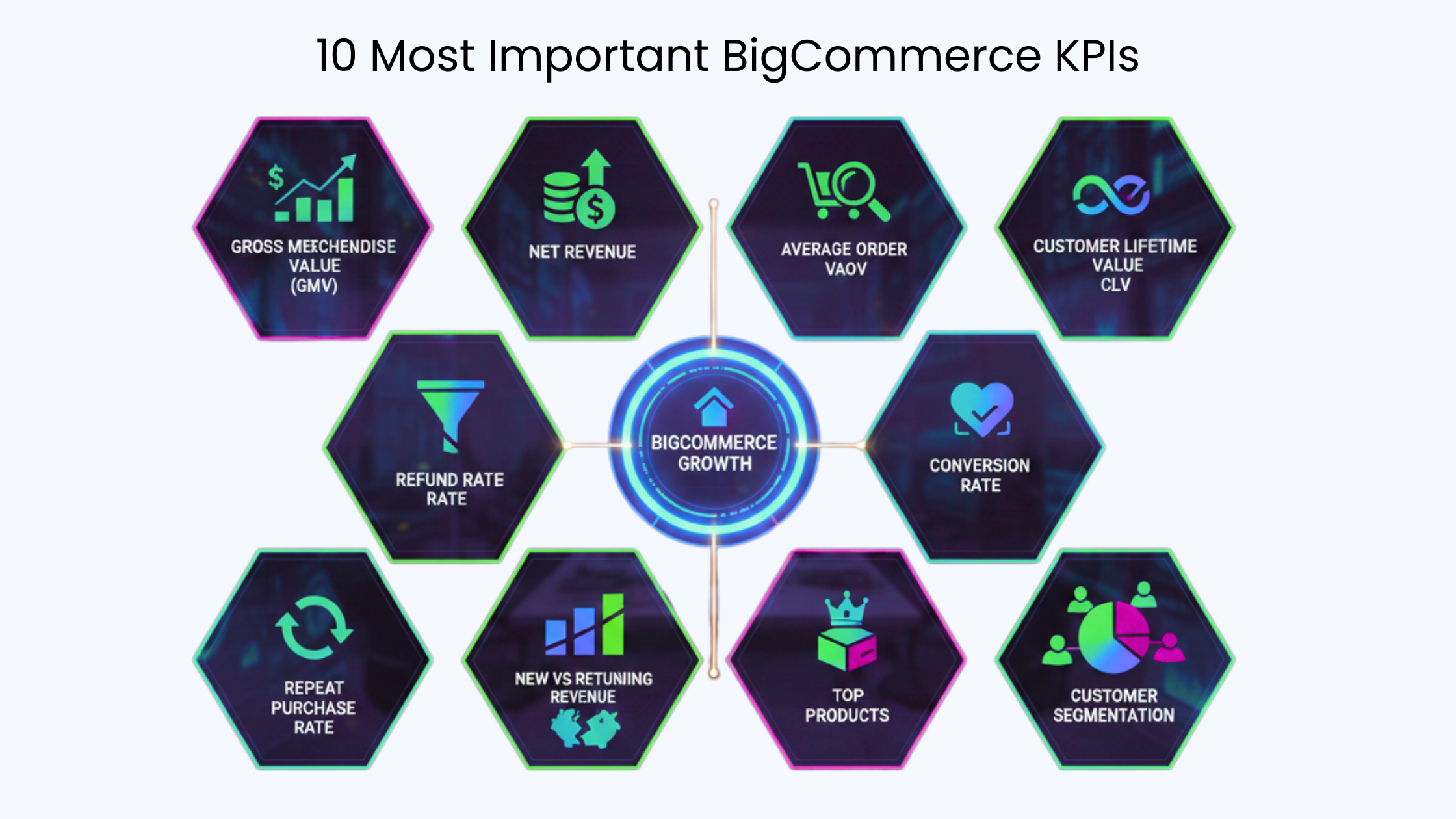
BigCommerce provides access to large amounts of eCommerce data, but data alone does not drive growth. Tracking the right BigCommerce KPIs helps store owners understand performance, identify issues early, and make better decisions based on real numbers.
This guide covers the most important BigCommerce metrics every store should monitor, what each KPI means, and why it matters for sustainable eCommerce growth.
What Are KPIs in BigCommerce?
Key Performance Indicators (KPIs) are measurable values that show how effectively your BigCommerce store is achieving business goals such as revenue growth, customer retention, and profitability.
Not all metrics are equally important. Vanity metrics can look good while hiding real problems. The KPIs below focus on revenue quality, customer behavior, and long-term performance.
Overview: 10 Essential BigCommerce KPIs
| KPI | Category | Why It Matters |
|---|---|---|
| Gross Merchandise Value (GMV) | Revenue | Measures total sales volume |
| Net Revenue | Revenue | Reflects actual earned revenue |
| Average Order Value (AOV) | Revenue | Improves revenue without more traffic |
| Conversion Rate | Performance | Indicates store and checkout effectiveness |
| Customer Lifetime Value (CLV) | Customer | Determines long-term customer value |
| Repeat Purchase Rate | Retention | Measures customer loyalty |
| Refund Rate | Risk | Reveals hidden revenue loss |
| New vs Returning Revenue | Growth | Shows sustainability of growth |
| Top Products | Product | Guides inventory and marketing |
| Customer Segmentation | Strategy | Enables targeted decision-making |
1. Gross Merchandise Value (GMV)
Definition: The total value of all completed orders before refunds and cancellations.
Why it matters: GMV shows demand and sales volume. It is useful for tracking overall growth trends, seasonality, and marketing impact.
Limitation: GMV does not reflect actual revenue earned.
2. Net Revenue
Definition: Revenue after refunds, failed payments, and cancellations.
Why it matters: Net revenue represents the money your business actually keeps. It is a more accurate KPI for financial planning, forecasting, and profitability analysis.
3. Average Order Value (AOV)
Definition: Total revenue divided by total number of orders.
Why it matters: Increasing AOV is often more cost-effective than acquiring new customers. Common strategies include bundles, upsells, and free shipping thresholds.
4. Conversion Rate
Definition: The percentage of website visitors who place an order.
Why it matters: Conversion rate reflects store usability, pricing, product presentation, and checkout performance.
A low conversion rate often signals:
- UX issues
- pricing friction
- trust or checkout problems
5. Customer Lifetime Value (CLV)
Definition: The total revenue a customer generates across all purchases.
Why it matters: CLV helps determine:
- how much you can spend on customer acquisition
- which customer segments are most valuable
- long-term growth potential
6. Repeat Purchase Rate
Definition: The percentage of customers who place more than one order.
Why it matters: High repeat purchase rates indicate strong retention and product-market fit. Returning customers typically cost less to convert and spend more over time.
7. Refund Rate
Definition: Refunded orders or refunded revenue as a percentage of total orders or revenue.
Why it matters: Refunds reduce revenue and distort performance metrics. High refund rates often point to product quality, fulfillment, or expectation issues.
8. New vs Returning Customer Revenue
Definition: Revenue split between first-time customers and returning customers.
Why it matters: This KPI shows whether growth is driven by retention or constant acquisition.
A healthy BigCommerce store balances:
- new customer acquisition
- returning customer revenue
9. Top Products by Revenue and Orders
Definition: Products ranked by total revenue and number of orders.
Why it matters: Identifying top-performing products helps with:
- inventory planning
- marketing focus
- pricing and bundling strategies
It also highlights underperforming products that may need optimization.
10. Customer Segmentation (Behavior-Based or RFM)
Definition: Grouping customers by behavior such as recency, frequency, and monetary value.
Why it matters: Customer segmentation allows you to:
- identify high-value customers
- detect churn risks early
- personalize marketing and retention efforts
Segmentation turns raw data into actionable insights.
How Often Should You Review BigCommerce KPIs?
| KPI Type | Review Frequency |
|---|---|
| Revenue & Conversion Metrics | Weekly |
| Retention & Customer KPIs | Monthly |
| Product Performance | Monthly |
| Segmentation & CLV | Quarterly |
Final Thoughts: Track KPIs That Drive Decisions
BigCommerce stores generate extensive data, but growth comes from clarity, not volume.
Tracking the right KPIs helps you:
- understand true revenue performance
- identify risks early
- focus on high-value customers
- make data-driven decisions with confidence
The goal is not to track more metrics, but to track the metrics that actually matter.
If you want to analyze BigCommerce KPIs, customer segments, and revenue trends without manual exports or spreadsheets, Chartsy was built to solve exactly that.

Written by
Chartsy TeamAnalytics team at Chartsy
The Chartsy Team writes guides, product updates, and resources to help SaaS and eCommerce founders make sense of their metrics, without SQL or spreadsheets.
Chartsy