
Churnkey and ProfitWell solve different parts of the retention problem. Churnkey focuses on recovery and cancellation flows, while ProfitWell is known for basic subscription metrics.
Here’s how the tools compare, where each one fits, and what to check before you choose.
Table of Contents
- Churnkey vs ProfitWell: Different Jobs, Different Best-Fit Teams
- Churn Analysis and Subscription Metrics
- Retention Automation, Failed Payments, and Cancellation Recovery
- Which Tool Should Your SaaS Choose?
- FAQ: Churnkey vs ProfitWell
- Conclusion
Churnkey vs ProfitWell: Different Jobs, Different Best-Fit Teams
Churnkey vs ProfitWell is less a fight between identical products and more a choice between two jobs. ProfitWell centers on basic MRR, churn, and LTV analysis. Churnkey centers on retention automation.
ProfitWell is the simpler starting point for a Stripe-based team that wants a free view of core subscription numbers. The research available for this comparison describes its analysis as basic MRR, churn, and LTV. It also notes email automation, but does not describe dee in the same detail.
That can be enough for an early team. If you need to check whether MRR rose this month or whether churn is moving in the wrong direction, a small metric set may do the job. The limit appears when you need to split the result by cohort, plan, source, or customer behavior.
Churnkey is aimed at teams with 200 or more customers that need customer success workflows. Its listed strengths include better AI retry logic, customer-side recovery flows, and cancellation flow integration. That points to a hands-on retention use case, where the team wants to act on a failed payment or a cancellation attempt.
Churnkey may be too much for a founder who only needs a monthly metrics check. ProfitWell may be too light for a team that has a customer success process and wants to recover accounts at the point of cancellation.
Use the job as your first filter. Need a metric baseline? Look at ProfitWell. Need retention actions inside the billing journey? Look at Churnkey.
Churn Analysis and Subscription Metrics
For churn analysis, the gap between Churnkey and ProfitWell comes down to what happens after a number appears. A churn rate tells you that customers left. It doesn’t tell you which customers left or what to change next.
ProfitWell’s documented comparison position is basic MRR, churn, and LTV. Those numbers give a useful starting point, especially for a team that has no reporting layer yet. But basic totals can hide the source of the loss.
For example, a stable customer churn rate can sit beside a sharp rise in revenue churn if larger accounts downgrade. The reverse can happen too. Many low-value customers may cancel while high-value accounts stay. A founder who checks only one churn number may make the wrong product or pricing call.
These metrics matter because they're linked. MRR shows the current recurring base. ARR gives a longer view of that base. NRR includes expansion and contraction from existing customers, while GRR focuses on what remains before expansion. LTV needs context from ARPU, retention, and acquisition cost.
The standard definition of customer attrition treats attrition as the loss of customers over time. In SaaS, you also need to track lost recurring revenue, because one account can represent far more MRR than another.
| Question your team has | ProfitWell | Churnkey |
|---|---|---|
| What is our basic MRR? | Yes, based on the research | Not stated |
| What is our churn rate? | Yes, basic analysis | Not stated |
| Which segments are losing MRR? | Depth not stated | Not stated |
| What is our LTV? | Yes, basic analysis | Not stated |
| Can the tool recover a failed payment? | Email automation is stated | Recovery automation is stated |
One more issue is data consistency. Before comparing tools, define whether churn means customer churn, revenue churn, or both. Set the same time window for every report. Otherwise, two dashboards can show different answers while both appear correct.
Retention Automation, Failed Payments, and Cancellation Recovery
In the Churnkey vs ProfitWell comparison, retention automation is where the products split most sharply. A metrics tool helps you see the loss. A recovery tool tries to stop the loss while the customer is still reachable.
Churnkey is the stronger match for teams focused on failed payments and cancellation moments.
Involuntary churn happens when a customer wants to stay but a payment fails. The cause may be an expired card, a bank decline, or another billing issue. Voluntary churn happens when the customer chooses to cancel. The right response is different in each case.
A retry flow can help with a payment failure. A cancellation flow may ask why the customer is leaving, suggest a pause, or present a lower plan. The exact tactic should match the reason for the cancellation. A customer leaving because of price needs a different path from one leaving because the product lacks a needed feature.
ProfitWell is described as handling email automation. That may suit teams that want a simple message sequence around billing or retention. It is less clearly suited to teams that need a customer success workflow inside the cancellation process.
But insight alone doesn’t change a customer’s billing state. If recovery is the immediate goal, you need to confirm the tool’s payment hooks, retry controls, cancellation screens, and handoff rules before signing up.
Subscriptions use a recurring billing system with lifecycle events. Your retention tool must read those events correctly, or your churn report and recovery workflow can drift apart.
Pro Tip: Split your retention review into two queues: customers who chose to leave and customers who failed to pay. Measure each group with a different action plan.
Churnkey is the better fit when automation is the main purchase reason. ProfitWell is a better fit when email support and basic metrics are enough.
Which Tool Should Your SaaS Choose?
The right choice depends on the problem your team can’t solve today. Don’t pick a retention tool because it has the longest feature list. Pick the one that matches the work your team will actually do each week.
Choose ProfitWell when cost is the main constraint and basic numbers cover your needs. You may outgrow it once you need cohort views or detailed segmentation.
Choose Churnkey when your team has enough customer volume to support real retention workflows. The research positions it for teams with 200 or more customers. That makes it a less natural starting point for a pre-revenue SaaS or a very small customer base.
Before you decide, write down five questions your team asks every month. Include one question about MRR, one about churn, one about retention, one about failed payments, and one about customer segments. Then test which tool can answer each question with the least manual work.
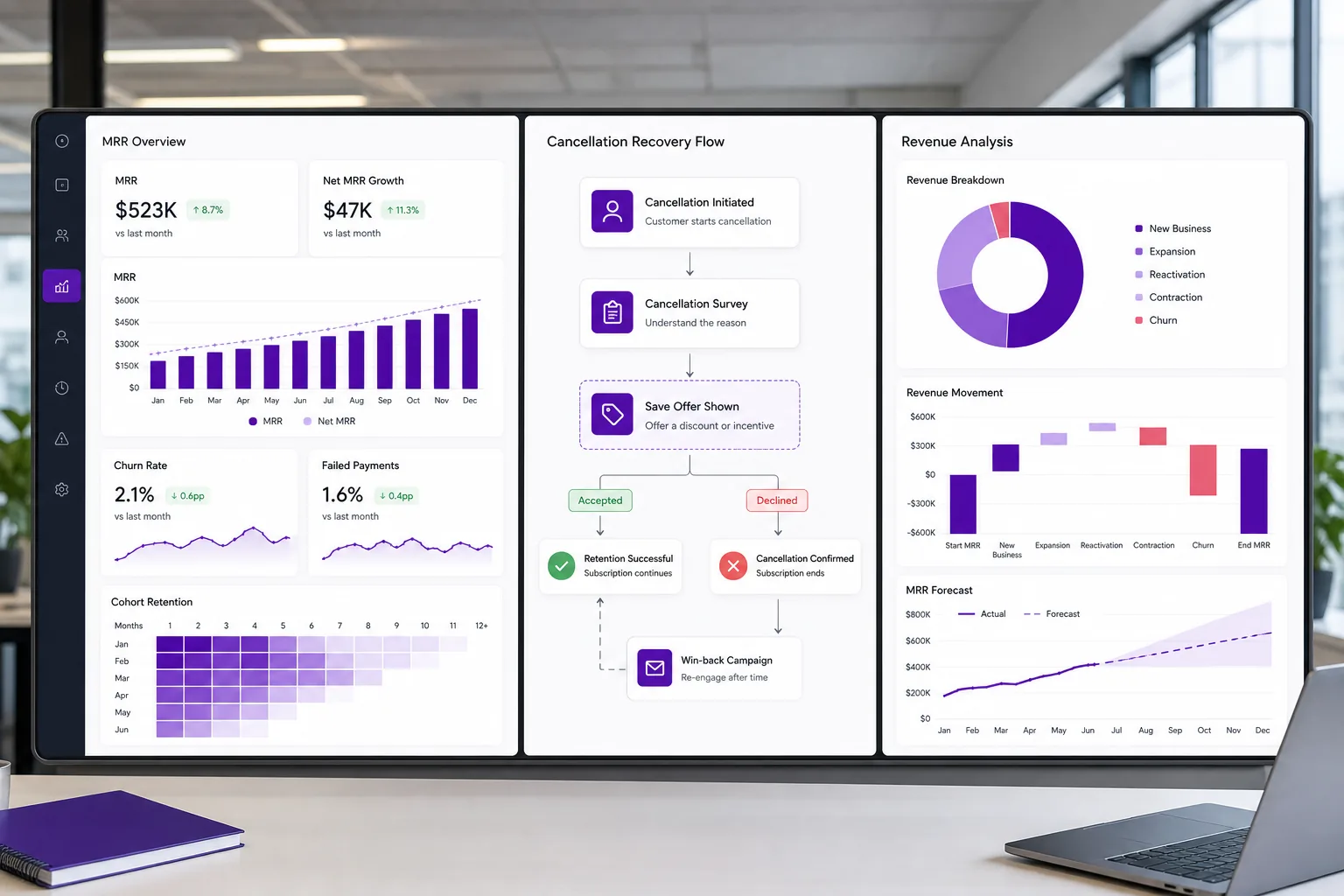
That test usually makes the choice plain. If the unanswered questions are about how to recover a customer right now, assess Churnkey. If you only need a free metric baseline, assess ProfitWell first.
FAQ: Churnkey vs ProfitWell
Is Churnkey better than ProfitWell?
Churnkey is better than ProfitWell when your main need is retention automation. It focuses on retry logic, customer-side recovery flows, and cancellation flow integration. ProfitWell is better suited to teams that want basic MRR, churn, and LTV metrics. The better choice depends on whether you need to act on churn or measure it.
Is ProfitWell really free?
ProfitWell is described as having a free tier for basic metrics. That makes it useful for an early Stripe-based team, but free access doesn’t mean deep analysis. Check whether it can answer your cohort, plan, segment, and revenue-churn questions.
Can Churnkey reduce failed payment churn?
Churnkey is positioned for failed payment recovery, with better AI retry logic and customer-side recovery flows listed among its capabilities. That makes it relevant to involuntary churn. Still, teams should test recovery rules against their own billing events and measure recovered revenue separately from voluntary cancellations.
Conclusion
Churnkey and ProfitWell answer different questions. If the urgent problem is recovery automation - retry logic, cancellation flows, and customer-side workflows at real volume - evaluate Churnkey. If budget is the blocker and a free view of basic MRR, churn, and LTV is enough for now, begin with ProfitWell and watch for the point where basic reports stop being enough.

Written by
Chartsy TeamAnalytics team at Chartsy
The Chartsy Team writes guides, product updates, and resources to help SaaS and eCommerce founders make sense of their metrics, without SQL or spreadsheets.
Chartsy